
Coming Soon
Here are the covers for my forthcoming sword and sorcery trilogy set in an alternative Ancient Egypt (Aegyptus) and featuring Thakar, a Northman, freebooter, pirate, sword for hire, and much more.
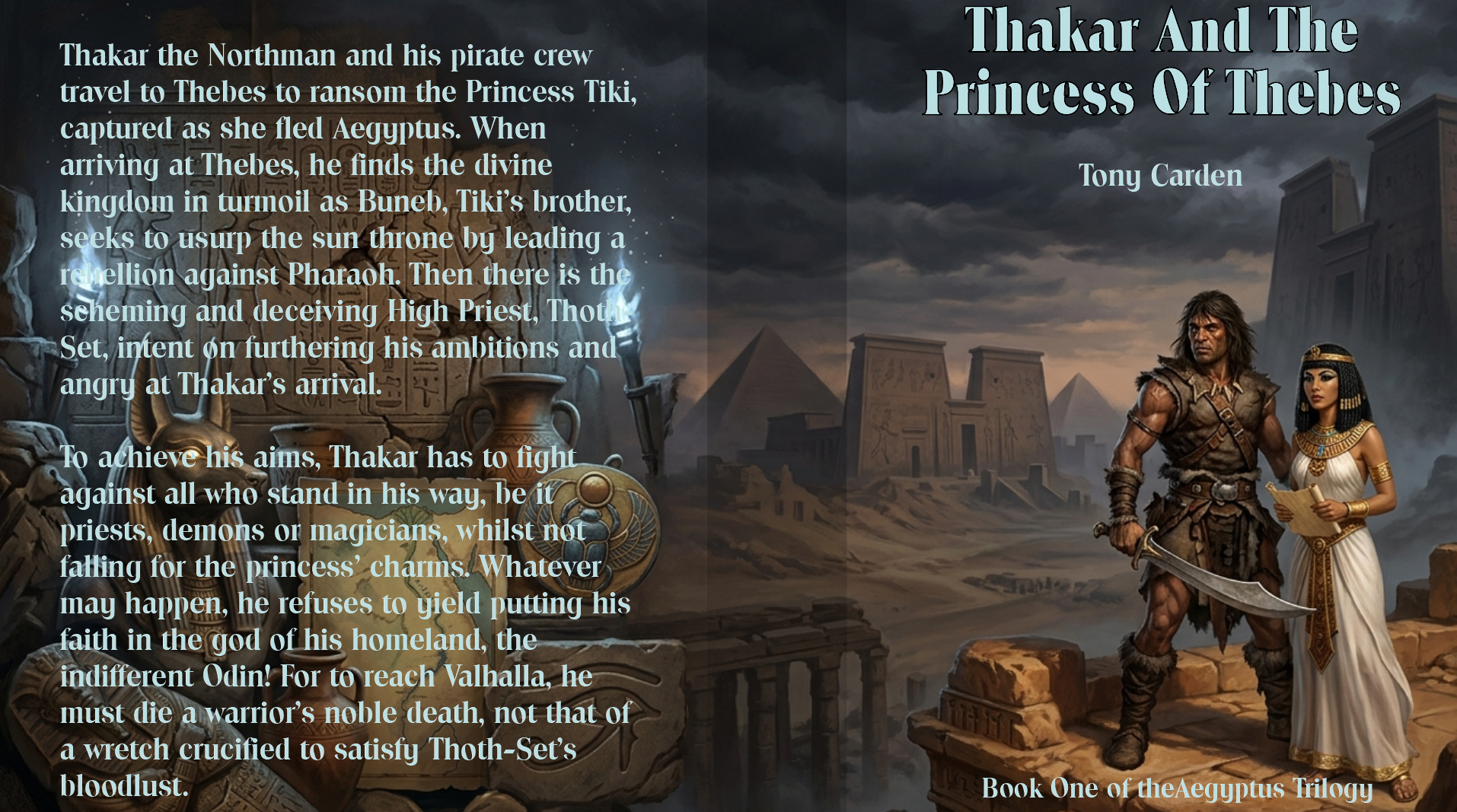
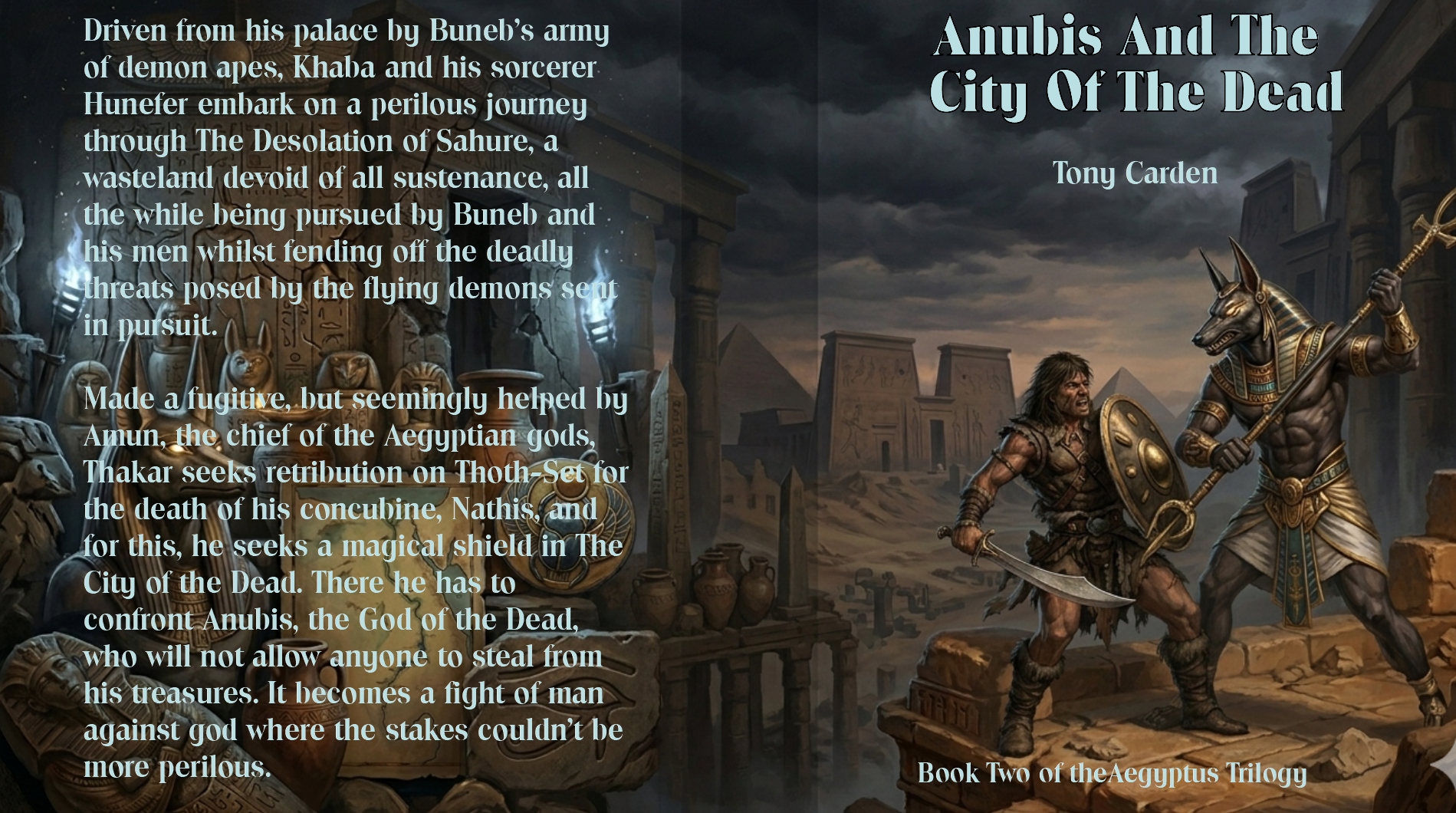
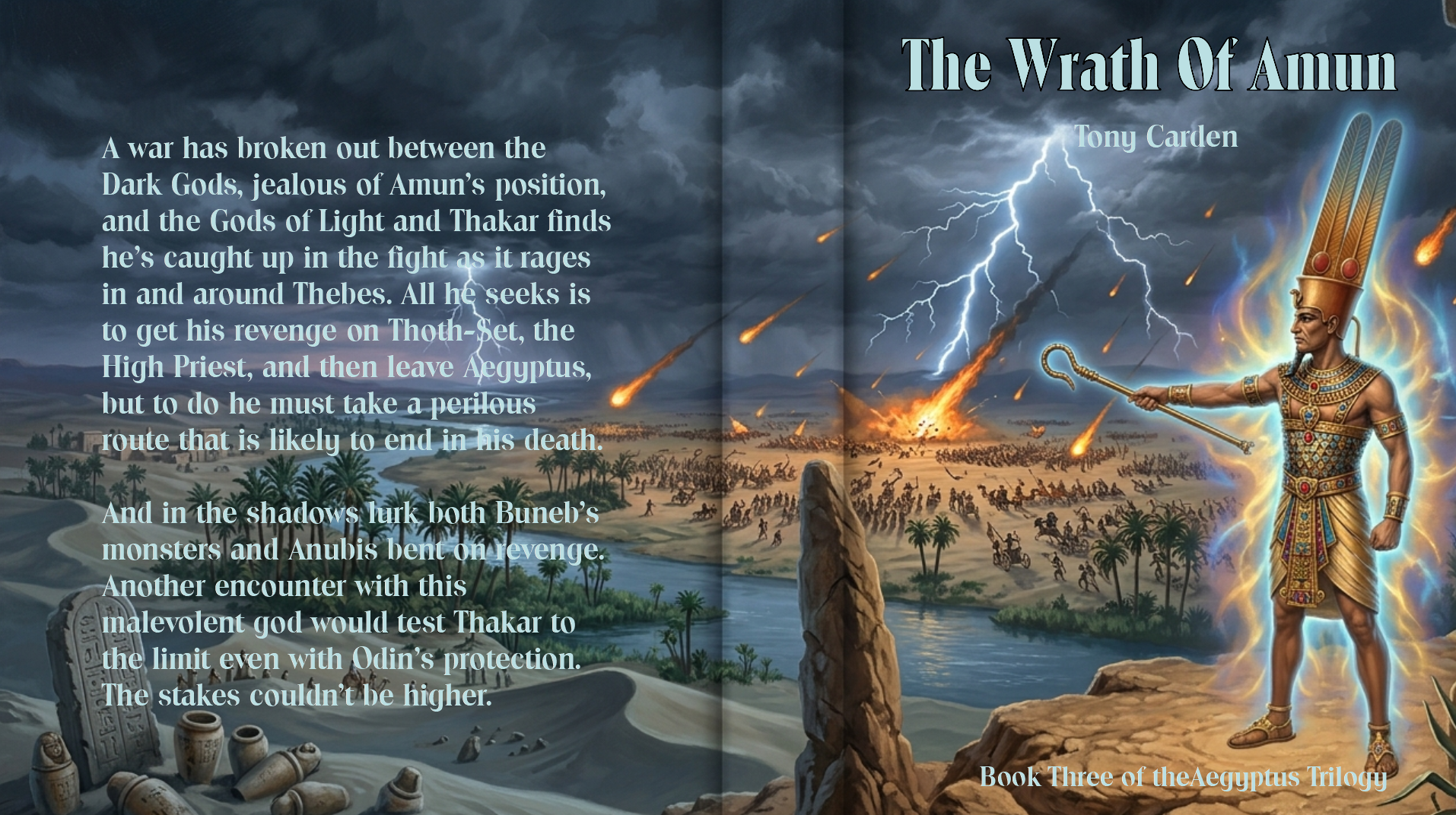
Generated Fairy Tale
And now a fairy tale generated by the plot generator Plot Generator - Infinite story ideas based on your input - Aardgo. (With edits.)
Daron Caldwell and the Three Sly, Faithful, Skilful Foxes
A Fairy Tale
by Tony Carden
Once upon a time, there was a cute boy called Daron Caldwell. He was on the way to see his Uncle Aeron Midhurst, when he decided to take a shortcut through The Elder Forest.
It wasn't long before Daron got lost. He looked around, but all he could see were trees. Nervously, he felt into his bag for his favourite toy, Catty, but Catty was nowhere to be found! Daron began to panic. He felt sure he had packed Catty. To make matters worse, he was starting to feel hungry.
Unexpectedly, he saw a sly, faithful, skilful fox dressed in a brown sleeveless jacket disappearing into the trees.
"How odd!" thought Daron.
For the want of anything better to do, he decided to follow the peculiarly dressed fox. Perhaps it could tell him the way out of the forest.
Eventually, Daron reached a clearing. He found himself surrounded by houses made from different sorts of food. There was a house made from greens, a house made from insect jelly, a house made from pot noodles and a house made from Vegemite.
Daron could feel his tummy rumbling. Looking at the houses did nothing to ease his hunger.
"Hello!" he called. "Is anybody there?"
Nobody replied.
Daron looked at the roof of the closest house and wondered if it would be rude to eat somebody else's chimney. Obviously, it would be impolite to eat a whole house, but perhaps it would be considered acceptable to nibble the odd fixture or lick the odd fitting, in a time of need.
A cackle broke through the air, frightening Daron. A witch jumped into the space in front of the houses. She was carrying a cage. In that cage was Catty!
"Catty!" shouted Daron. He turned to the witch. "That's my toy!"
The witch just shrugged.
"Give Catty back!" cried Daron.
"Not on your nelly!" said the witch.
"At least let Catty out of that cage!"
Before she could reply, three foxes rushed in from a footpath on the other side of the clearing. Daron recognised the one in the brown sleeveless jacket that he'd seen earlier but not the others. The witch seemed to recognise him too.
"Hello, Big Fox," said the witch. She ignored the others.
"Good morning." The fox noticed Catty. "Who is this?"
"That's Catty," explained the witch.
"Ooh! Catty would look lovely in my house. Give it to me!" demanded the fox.
The witch shook her head. "Catty is staying with me."
"Um... Excuse me..." Daron interrupted. "Catty lives with me! And not in a cage!"
Big Fox ignored him. "Is there nothing you'll trade?" he asked the witch.
The witch thought for a moment, then said, "I do like to be entertained. I'll release him to anybody who can eat a whole front door."
Big Fox looked at the house made from Vegemite and said, "No problem, I could eat an entire house made from Vegemite if I wanted to."
"That's nothing," said the next fox. "I could eat two houses."
"There's no need to show off," said the witch. Just eat one front door, and I'll let you have Catty."
Daron watched, feeling very worried. He didn't want the witch to give Catty to Big Fox. He didn't think Catty would like living with a sly, faithful, and skilful fox, away from his house and all his other toys.
The other two foxes watched while Big Fox put on his bib and withdrew a knife and fork from his pocket.
"I'll eat this whole house," said Big Fox, Horse, Falcon. "Just you watch!"
Big Fox pulled off a corner of the front door of the house made from insect jelly. He gulped it down, smiling, and went back for more.
And more.
And more.
Eventually, Big Fox started to get bigger - just a little bit bigger at first. But after a few more fork-fulls of insect jelly, he grew to the size of a large snowball - and he was every bit as round.
"Erm... I don't feel too good," said Big Fox.
Suddenly, he started to roll. He'd grown so round that he could no longer balance!
"Help!" he cried, as he rolled off down a slope into the forest.
Big Fox never finished eating the front door made from insect jelly, and Catty remained trapped in the witch's cage.
Average Fox stepped up and approached the house made from pot noodles.
"I'll eat this whole house," said Average Fox, Horse, Falcon. "Just you watch!"
Average Fox pulled off a corner of the front door of the house made from pot noodles. She gulped it down, smiling, and went back for more.
And more.
And more.
After a while, Average Fox started to look a little queasy. She grew greener...
...and greener.
A woodcutter walked into the clearing. "What's this bush doing here?" he asked.
"I'm not a bush, I'm a fox!" said Average Fox.
"It talks!" exclaimed the woodcutter. "Those talking bushes are the worst kind. I'd better take it away before somebody gets hurt."
"No! Wait!" cried Average Fox, as the woodcutter picked her up. But the woodcutter ignored her cries and carried the fox away under his arm.
Average Fox never finished eating the front door made from pot noodles, and Catty remained trapped in the witch's cage.
Little Fox stepped up and approached the house made from Vegemite.
"I'll eat this whole house," said Little Fox. "Just you watch!"
Little Fox pulled off a corner of the front door of the house made from Vegemite. He gulped it down, smiling, and went back for more.
And more.
And more.
After five or six platefuls, Little Fox started to fidget uncomfortably on the spot.
He stopped eating Vegemite for a moment, then grabbed another forkful.
But before he could eat it, there came an almighty roar. A bottom burp louder than a rocket taking off propelled Little Fox into the sky.
"Aggghhhhhh!" cried Little Fox. "I'm scared of heigh..."
Little Fox was never seen again.
Little Fox never finished eating the front door made from Vegemite, and Catty remained trapped in the witch's cage.
"That's it," said the witch. "I win. I get to keep Catty."
"Not so fast," said Daron. "There is still one front door to go. The front door of the house that is made from greens. And I haven't had a turn yet.
"I don't have to give you a turn!" laughed the witch. "My game. My rules."
The woodcutter's voice carried through the forest. "I think you should give him a chance. It's only fair."
"Fine," said the witch. "But you saw what happened to the foxes. He won't last long."
"I'll be right back," said Daron.
"What?" said the witch. "Where's your sense of impatience? I thought you wanted Catty back."
Daron ignored the witch and gathered a hefty pile of sticks. He came back to the clearing and started a small campfire. Carefully, he broke off a piece of the door of the house made from greens and toasted it over the fire. Once it had cooked and cooled just a little, he took a bite. He quickly devoured the whole piece.
Daron sat down on a nearby log.
"You fail!" cackled the witch. "You were supposed to eat the whole door."
"I haven't finished," explained Daron. "I am just waiting for my food to go down."
When Daron's food had digested, he broke off another piece of the door made from greens. Once more, he toasted his food over the fire and waited for it to cool just a little. He ate it at a leisurely pace, then waited for it to digest.
Eventually, after several sittings, Daron was down to the final piece of the door made from greens. Carefully, he toasted it and allowed it to cool just a little. He finished his final course. Daron had eaten the entire front door of the house, made from greens.
The witch stamped her foot angrily. "You must have tricked me!" she said. "I don't reward cheating!"
"I don't think so!" said a voice. It was the woodcutter. He walked back into the clearing, carrying his axe. "This little boy won fair and square. Now hand over Catty, or I will chop your broomstick in half."
The witch looked horrified. She grabbed her broomstick and placed it behind her. Then, huffing, she opened the door of the cage.
Daron hurried over and grabbed Catty, checking that his favourite toy was all right. Fortunately, Catty was unharmed.
Daron thanked the woodcutter, grabbed a quick souvenir, and hurried on to meet Aeron. It was starting to get dark.
When Daron got to Aeron's house, his Uncle threw his arms around him.
"I was so worried!" cried Aeron. "You are very late."
As Daron described his day, he could tell that Aeron didn't believe him. So he grabbed a napkin from his pocket.
"What's that?" asked Aeron.
Daron unwrapped a doorknob made from insect jelly. "Pudding!" he said.
Aeron almost fell off his chair.
The End
A Random Script
This is created using Plot Generator - Infinite story ideas based on your input - Aardgo as a piece of fun. Whilst obviously machine-generated, it’s quite fun, so I am posting it here. (I may have already done so; but I haven’t checked.)
Enjoy!
Cruel Yeti
Smart waitress MISS LYDIANNE MCKENSIE is arguing with sensible chef MR EVERETT BLANDON. LYDIANNE tries to hug EVERETT but he shakes her off.
LYDIANNE
Please Everett, don't leave me.
EVERETT
I'm sorry Lydianne, but I'm looking for somebody a bit more brave. Somebody who faces her fears head on, instead of running away.
LYDIANNE
I am such a person!
EVERETT frowns.
EVERETT
I'm sorry, Lydianne. I just don't feel excited by this relationship anymore.
EVERETT leaves.
LYDIANNE sits down, looking defeated.
Moments later, cocky waitress MISS JEMIMA ELVERET barges in looking flustered.
LYDIANNE
Goodness, Jemima! Is everything okay?
JEMIMA
I'm afraid not.
LYDIANNE
What is it? Don't keep me in suspense...
JEMIMA
It's ... a yeti ... I saw an evil yeti dismember a bunch of hikers!
LYDIANNE
Defenseless hikers?
JEMIMA
Yes, defenseless hikers!
LYDIANNE
Bloomin' heck, Jemima! We've got to do something.
JEMIMA
I agree, but I wouldn't know where to start.
LYDIANNE
You can start by telling me where this happened.
JEMIMA
I was...
JEMIMA fans herself and begins to wheeze.
LYDIANNE
Focus Jemima, focus! Where did it happen?
JEMIMA
a wood! That's right - a wood!
LYDIANNE springs up and begins to run.
EXT. A ROAD - CONTINUOUS
LYDIANNE rushes along the street, followed by JEMIMA. They take a short cut through some back gardens, jumping fences along the way.
EXT. A WOOD - SHORTLY AFTER
CHANNING DELARIO a cruel yeti terrorises two hikers.
LYDIANNE, closely followed by JEMIMA, rushes towards CHANNING, but suddenly stops in her tracks.
JEMIMA
What is is? What's the matter?
LYDIANNE
That's not just any old yeti, that's Channing DeLario!
JEMIMA
Who's Channing DeLario?
LYDIANNE
Who's Channing DeLario? Who's Channing DeLario? Only the most cruel yeti in the universe!
JEMIMA
Blinkin' knickers, Lydianne! We're going to need some help if we're going to stop the most cruel yeti in the universe!
LYDIANNE
You can say that again.
JEMIMA
Blinkin' knickers, Lydianne! We're going to need some help if we're going to stop the most cruel yeti in the universe!
LYDIANNE
I'm going to need spades, lots of spades.
Channing turns and sees Lydianne and Jemima. She grins an evil grin.
CHANNING
Lydianne McKensie, we meet again.
JEMIMA
You've met?
LYDIANNE
Yes. It was a long, long time ago...
EXT. A PARK - BACK IN TIME
A young LYDIANNE is sitting in a park listening to some folk music, when suddenly a dark shadow casts over her.
She looks up and sees CHANNING. She takes off her headphones.
CHANNING
Would you like some Kit Kats?
LYDIANNE's eyes light up, but then he studies CHANNING more closely, and looks uneasy.
LYDIANNE
I don't know, you look kind of cruel.
CHANNING
Me? No. I'm not cruel. I'm the least cruel yeti in the world.
LYDIANNE
Wait, you're a yeti?
LYDIANNE runs away, screaming.
EXT. A WOOD - PRESENT DAY
CHANNING
You were a coward then, and you are a coward now.
JEMIMA
(To LYDIANNE) You ran away?
LYDIANNE
(To JEMIMA) I was a young child. What was I supposed to do?
LYDIANNE turns to CHANNING.
LYDIANNE
I may have run away from you then, but I won't run away this time!
LYDIANNE runs away.
She turns back and shouts.
LYDIANNE
I mean, I am running away, but I'll be back - with spades.
CHANNING
I'm not scared of you.
LYDIANNE
You should be.
INT. A KITCHEN - LATER THAT DAY
LYDIANNE and JEMIMA walk around searching for something.
LYDIANNE
I feel sure I left my spades somewhere around here.
JEMIMA
Are you sure? It does seem like an odd place to keep deadly spades.
LYDIANNE
You know nothing Jemima Elveret.
JEMIMA
We've been searching for ages. I really don't think they're here.
Suddenly, CHANNING appears, holding a pair of spades.
CHANNING
Looking for something?
JEMIMA
Crikey, Lydianne, she's got your spades.
LYDIANNE
Tell me something I don't already know!
JEMIMA
The earth's circumference at the equator is about 40,075 km.
LYDIANNE
I know that already!
JEMIMA
fear of heights.
CHANNING
(appalled) Dude!
While CHANNING is looking at JEMIMA with disgust, LYDIANNE lunges forward and grabs her deadly spades. He wields them, triumphantly.
LYDIANNE
Prepare to die, you cruel leek!
CHANNING
No please! All I did was dismember a bunch of hikers!
EVERETT enters, unseen by any of the others.
LYDIANNE
I cannot tolerate that kind of behaviour! Those hikers were defenceless! Well now they have a defender - and that's me! Lydianne McKensie defender of innocent hikers.
CHANNING
Don't hurt me! Please!
LYDIANNE
Give me one good reason why I shouldn't use these spades on you right away!
CHANNING
Because Lydianne, I am your mother.
LYDIANNE looks stunned for a few moments, but then collects herself.
LYDIANNE
No you're not!
CHANNING
Ah well, it had to be worth a try.
CHANNING tries to grab the spades but LYDIANNE dodges out of the way.
LYDIANNE
Who's the mummy now? Huh? Huh?
Unexpectedly, CHANNING slumps to the ground.
JEMIMA
Did she just faint?
LYDIANNE
I think so. Well that's disappointing. I was rather hoping for a more dramatic conclusion, involving my deadly spades.
LYDIANNE crouches over CHANNING's body.
JEMIMA
Be careful, Lydianne. It could be a trick.
LYDIANNE
No, it's not a trick. It appears that... It would seem... Channing DeLario is dead!
LYDIANNE
What?
LYDIANNE
Yes, it appears that I scared her to death.
JEMIMA claps her hands.
JEMIMA
So your spades did save the day, after all.
EVERETT steps forward.
EVERETT
Is it true? Did you kill the cruel yeti?
LYDIANNE
Everett how long have you been...?
EVERETT puts his arm around LYDIANNE.
EVERETT
Long enough.
LYDIANNE
Then you saw it for yourself. I killed Channing DeLario.
EVERETT
Then the hikers are safe?
LYDIANNE
It does seem that way!
A crowd of vulnerable hikers enter, looking relived.
EVERETT
You are their hero.
The hikers bow to LYDIANNE.
LYDIANNE
There is no need to bow to me. I seek no worship. The knowledge that Channing DeLario will never dismember hikers ever again, is enough for me.
EVERETT
You are humble as well as brave!
One of the hikers passes LYDIANNE a weird mobile
EVERETT
I think they want you to have it, as a symbol of their gratitude.
LYDIANNE
I couldn't possibly.
Pause.
LYDIANNE
Well, if you insist.
LYDIANNE takes the mobile.
LYDIANNE
Thank you.
The hikers bow their heads once more, and leave.
LYDIANNE turns to EVERETT.
LYDIANNE
Does this mean you want me back?
EVERETT
Oh, Lydianne, of course I want you back!
LYDIANNE smiles for a few seconds, but then looks defiant.
LYDIANNE
Well you can't have me.
EVERETT
WHAT?
LYDIANNE
You had no faith in me. You had to see my scare a yeti to death before you would believe in me. I don't want a lover like that.
EVERETT
But...
LYDIANNE
Please leave. I want to spend time with the one person who stayed with me through thick and thin - my best friend, Jemima.
JEMIMA grins.
EVERETT
But...
JEMIMA
You heard the lady. Now be off with you. Skidaddle! Shoo!
EVERETT
Lydianne?
LYDIANNE
I'm sorry Everett, but I think you should skidaddle.
EVERETT leaves.
JEMIMA turns to LYDIANNE.
JEMIMA
Did you mean that? You know ... that I'm your best friend?
LYDIANNE
Of course you are!
The two walk off arm in arm.
Suddenly JEMIMA stops.
JEMIMA
When I said fear of heights, you know I was just trying to distract the yeti don't you?
THE END
Dungeons and Dragons, The Movie
Well, well, well. I loved this movie for probably all the wrong reasons. First of all, the actors got into the spirit and gave their all. But what really tickled me most of all was the sheer number of tropes that were either gaily used and then subverted or twisted. Hence, while both formulaic and predictable, it worked a treat. It won’t be giving away anything about the plot to say that the good guys, a bunch of losers and/or emotionally deficient characters, face the overpowering evil that—and it has to be this to raise the stakes beyond the usual death to all—threatens the entire world. It’s as if the worst group of dysfunctional individuals were commanded to save the world because nobody else can. As such, it reminded me a lot of Guardians of the Galaxy in style and content, another great (but it shouldn’t work!) movie.
The action fairly rolls along with some great dialogue that should have had the actors splitting their sides, but somehow they managed to retain their guffaws. I also very much enjoyed the allusions to a ‘famous’ fantasy movie trilogy based on a much-loved novel, perhaps the foundation book for all modern fantasy. This aspect of the movie was subtle, and you had to look carefully to see these.
Another lovely aspect is the various scenes that have wonderful and very amusing action, and the reactions of the characters, and so on to the unexpected developments. In this, their over-the-top acting was perfect to set the light, yet internally serious, tone of the story. It is this tension between self-mockery and serious fantasy that gives the movie its edge.
Also, the gags are well-conceived and work well to lighten their tone; they made this viewer chuckle.
Of course, all this plays to the fact that I do something of the same (but in a different way) in my fantasy comedy The Sorcerer’s Lackey. One recognises a fellow satirist in action.
A great effort by everyone involved and IMHO, definitely worth a viewing even if comic fantasy isn’t your thing.
Empires of Destiny
Some years ago, I had this story idea. There is a group of individuals who, through magic, could see the outcome of events in the future. They end up being the rulers of an empire, an empire that, due to their magic, was destined to conquer the whole world, hence the Empires of Destiny. No, the plural in the title is correct, for I envisaged a countervailing force, another empire that also sought to mould the world through magic.
Now I actually spent a lot of time planning this novel, which goes against my pantser instincts. It didn’t work well. The plot begins with a scout, possibly an assassin from another part of the world, who is ‘invisible’ to the ruling caste, who are these viewers of the future directing history to build an empire by changing events in their favour, finding this individual in their sanctum of sactums. He is subsequently executed, and the inquisitor is later killed by the intruder’s companion, who in turn is chased by a guard. This guard doesn’t know it, but the ruling elite murdered his entire family as they were predicted to be a future threat to the order. It was only by chance that the character survived the extermination. This past will be a later reveal.
There’s lots more: six different magics, a world with a lot of diversity and varied topography. I even decided to base the empire on Ancient China giving the characters Chinese names.
Why didn’t it work for the above is a reasonable basis for a story. The answer is simple: the plot absolutely sucked. It was turgid, predictable and ultimately very unsatisfying. I just couldn’t make it work, though I wish I could, for I still like the idea.
SAMPLE SECTION OF EMPIRES OF DESTINY
Syaoran gazed up at the pillars of the Great Hall that reached up to the domed roof. The complex arrangements of windows allowed the sun to shine through and reflect off the sides to scatter across the vast space. Some rays fell on the ground as pools of light to brighten the demi dark of the hall. Others on the pillars so that their ornate bas-reliefs were legible. Even though he’d seen the sight many times before, it always awed him to see the repeated pattern of Dhuze sigils between the pictograms of the empire’s history. They showed how the influence of the Dhuze had grown from its humble origins within the present capital to an empire that now had most of the known world under its sway. Only a few outposts, the distant Thorn Islands and beyond the Great Wasteland, the trader cities of Calphram, remained independent. Only their remoteness had preserved them from being absorbed by the empire.
His footsteps sounded hollow in the vastness as he made his way to the Conclave. The call to meet had caught him at rest after a late night. Even so, he’d dressed and come as soon as the messenger had informed him. Assemblies were few and far between, and so the sudden request had surprised him and piqued his interest.
Out of the gloom, he spotted Thalan. Or rather, he’d been spotted, for the man made to intercept his path. Syaoran slowed to make the man wait for him. It would set the tone for their discussion.
Thalan smiled as if understanding the subtle message in his behaviour. While they spoke on occasion, it was not like the man to seek him out. It intrigued him as to why he’d want to talk to a rival ahead of the Conclave.
Syaoran bowed slightly. “Thalan, I would have thought you had more pressing work than coming to this meeting.”
Thalan chuckled, “It is so rare we meet in Conclave, I felt I might be present to see what the Circle wishes to impart to us.” Syaoran full well knew that those of the Circle only communicated with Throns and Arcts, such as he, when they considered their visions of the future to be important enough for the empire to act.
He took Syaoran’s arm. “Let us go together.” It would have been impolite and created more enmity than already existed if he’d objected, so he let Tholan lead him on.
Out of curiosity, Syaoran asked, “Have you discerned the purpose of the meeting, then?”
“Why perceive this when I’ll know soon enough?” Thalan wagged a finger at him. “You’d be foolish to become a dreamer before your day by such behaviour.”
It was true. Syaoran had no intention of speeding his descent into the mindlessness that was the eventual fate of all dhurze. Despite the ever-present lure of wanting to know what was to happen, only the most important of reasons would get him to read the future paths. Even so, he was already feeling the way present and future paths were merging as what he saw in front of him meshed with what might be. “We all dream, Thalan.”
“Ah, of course, as an Arcts you consider it is our destiny to dream and to change the direction of this world as you see fit. It is arrogance, of course.”
Syaoran dismissed his comment with a gesture. “And I suppose you Throns would nothing in the face of fortune and just watch as the empire fractured.”
“You malign us. We are all for the empire and its success. But what you’re doing to the world is perilous.”
Syaoran put up a hand to stop him from continuing. “No. It is what you won’t do that is dangerous.”
“And the rift that occurred this very day here in the square?”
The idea that the very fabric of reality might somehow come asunder was crazy. He’d witnessed the execution, and apart from a roar from the crowd, the event had passed like all such others. The idea that reality might rift and reset, which underpinned the Thron reluctance to manipulate events, was the product of an overactive imagination and a misreading of what dreamers perceived. “Ah, the rift. I wondered how long before you brought it up.”
“You don’t deny it is somewhere there in the future.”
They’d had this argument before, only it had become more heated over time. Now Thalon was pushing the dangers of interfering with the future by acting on its future paths to move reality in the desired direction, citing the risk of a rift as the reason. Thus, those like Thalon were advocating a period of abstinence from foretelling to allow reality to consolidate. Fortunately, amongst the Conclave, only a few leaned towards this surrendering of dhurze power. But they were vocal and questioned every move by those, such as he, who saw the ability to foresee as their right to rule and better the world.
Mark couldn’t stop himself from puncturing the man’s ego. “Some say they’ve sensed it. But they’ve been saying that for generations. My teacher said it was a weakness in the diviner.”
“Of course, blame the messenger.”
“You can believe what you wish, of course.”
“I will.”
Their conversation had brought them to the entrance of the Conclave. Other dhurze appeared from the shadows. The call to meet had brought them from their various tasks. Undoubtedly, like he was, they were curious as to the reasons.
The Conclave meeting hall was round with tiered seats and a central open circle where speakers could address the assembly. Like the Great Hall, the walls had been decorated with brightly painted bas-reliefs such that it appeared as if one stood in the middle of a frozen crowd of the empire’s greatest heroes.
He followed Thalan and found a place behind the first row, which would be occupied by the Circle and beside other Arcts. By some tacit understanding, each group would sit together. He noticed Thalan take a place near the leader of the Throns.
A gong announced the arrival of the Circle. Syaoran examined the seven of them as they entered. He’d not seen them in a long time, these Dhruze leaders. Two seemed bewildered by the assembly. Syaoran knew the signs; these two would soon join the dreamers. He smiled. It meant there’d be some jostling to see who would replace them. Worthy successors who’d used their talent to the point where they could read years ahead, the future’s many paths.
The Circle took their places.
From close by him, Eland stood up and moved into the centre of the hall. While not the most senior Dhruze, he was in practice, due to the way members of the Circle would drift in and out of the present; he was, to all intents and purposes, the senior Conclave member present.
Eland turned a full circle, examining those present. He then bowed to the Circle. “The Conclave is in session,” Eland said. And to the Conclave, he intoned, “I speak for the Circle.”
In echo, Syaoran and those present chanted back, “You speak for the Circle.”
Eland called out, “Let it be unbroken.”
“The Circle is complete.”
“Indeed, it is complete,” Eland replied.
The preliminaries over, he raised both hands. “We meet but seldom, so you’re wondering why we are assembled at this early hour. Only the direst contingency would call for that. And we confront the biggest challenge ever to face us since we created the empire.” Syaoran noted his words had captured everyone’s attention—including his own. How could there be an emergency?
“This very night, brother Alund was assassinated.”
If Eland’s words had intended to create an uproar, they succeeded. All around Syaoran, people began shouting questions. Syaoran managed to restrain himself from adding to the clamour. Eland would explain soon enough. But the reason for the Conclave was now clear. The murder of one of their own. It was an impossibility. Dhurze read the future and feared nothing since they could avoid it. There was no question Alund could have missed such a threat. As those about him were bellowing, there had to be some mistake. But he knew Eland, the man didn’t make mistakes and inventing stories to create a disturbance wasn’t like him.
“Silence. Silence. Let us hear what Eland has to say.” Somehow, Thalan had been able to cut through the uproar.
The noise subsided to a rumble and then silence.
Eland swept his hand at those facing him. “You see the import of this. But there is more. As you know, Alund took charge of ensuring the safety of the Citadel. Two nights ago, a thief was caught prowling these very halls. Alund interrogated him personally. The prisoner claimed to be a simple burglar after riches. Given his willingness to confess, he wasn’t put to the torture. Alund scanned what the man said in those futures where he was tortured, and these agreed with his story. Consequently, he was condemned to death for his crime and subsequently publicly executed this afternoon.”
Thalan got to his feet. “Are you saying this thief and Alund’s death are linked?”
“I do, brother Thalan,” Eland said. He waved the man down. “Please be seated. All will be revealed in a moment.” He checked to see if no one else was going to interrupt. “We now know that Alund’s assassin is the thief’s associate. She followed him and stabbed him to death whilst he was eating his supper.”
“Have you caught her, then?”
Eland frowned at the speaker. “Don’t interrupt. I said I’d explain. Her attack was witnessed by others at the eatery. A young officer there chased her. Unfortunately, she managed to evade him. Since then, we’ve been able to track her whereabouts to some extent. We know she’s escaped the capital and is heading in the direction of the Great Wasteland.”
Thalan was on his feet again. “That means it’s Calphram’s doing. What did they hope to achieve by sending agents against us?”
“Our very question. Since the murder, many hours have gone into seeing what this portends.” Eland gestured at the two Circle members Syaoran had considered earlier. “Consequently, we have learned much. You’re right in thinking it’s Calphram’s handiwork. For as long as we’ve known about them, they’ve led us to believe they’re at the end of the world and that all beyond their far border is more wasteland. Given our preoccupations and their evident weakness, we readily swallowed their lies. But everything they told us is a lie. A lie they’ve been spinning to us for generations. What we’ve discovered this very night is that there’s a country beyond Calphram! A country that threatens us, for it’s from there that our thief and assassin come.”
This is really brilliant
Cruel Yeti
A Screenplay by Tony Carden*
INT. THE SUBWAY - AFTERNOON
Smart waitress MISS LYDIANNE MCKENSIE is arguing with sensible chef MR EVERETT BLANDON. LYDIANNE tries to hug EVERETT but he shakes her off.
LYDIANNE
Please Everett, don't leave me.
EVERETT
I'm sorry Lydianne, but I'm looking for somebody a bit more brave. Somebody who faces her fears head on, instead of running away.
LYDIANNE
I am such a person!
EVERETT frowns.
EVERETT
I'm sorry, Lydianne. I just don't feel excited by this relationship anymore.
EVERETT leaves.
LYDIANNE sits down, looking defeated.
Moments later, cocky waitress MISS JEMIMA ELVERET barges in looking flustered.
LYDIANNE
Goodness, Jemima! Is everything okay?
JEMIMA
I'm afraid not.
LYDIANNE
What is it? Don't keep me in suspense...
JEMIMA
It's ... a yeti ... I saw an evil yeti dismember a bunch of hikers!
LYDIANNE
Defenseless hikers?
JEMIMA
Yes, defenseless hikers!
LYDIANNE
Bloomin' heck, Jemima! We've got to do something.
JEMIMA
I agree, but I wouldn't know where to start.
LYDIANNE
You can start by telling me where this happened.
JEMIMA
I was...
JEMIMA fans herself and begins to wheeze.
LYDIANNE
Focus Jemima, focus! Where did it happen?
JEMIMA
A wood! That's right - a wood!
LYDIANNE springs up and begins to run.
EXT. A ROAD - CONTINUOUS
LYDIANNE rushes along the street, followed by JEMIMA. They take a short cut through some back gardens, jumping fences along the way.
EXT. A WOOD - SHORTLY AFTER
CHANNING DELARIO a cruel yeti terrorises two hikers.
LYDIANNE, closely followed by JEMIMA, rushes towards CHANNING, but suddenly stops in her tracks.
JEMIMA
What is is? What's the matter?
LYDIANNE
That's not just any old yeti, that's Channing DeLario!
JEMIMA
Who's Channing DeLario?
LYDIANNE
Who's Channing DeLario? Who's Channing DeLario? Only the most cruel yeti in the universe!
JEMIMA
Blinkin' knickers, Lydianne! We're going to need some help if we're going to stop the most cruel yeti in the universe!
LYDIANNE
You can say that again.
JEMIMA
Blinkin' knickers, Lydianne! We're going to need some help if we're going to stop the most cruel yeti in the universe!
LYDIANNE
I'm going to need spades, lots of spades.
Channing turns and sees Lydianne and Jemima. She grins an evil grin.
CHANNING
Lydianne McKensie, we meet again.
JEMIMA
You've met?
LYDIANNE
Yes. It was a long, long time ago...
EXT. A PARK - BACK IN TIME
A young LYDIANNE is sitting in a park listening to some folk music, when suddenly a dark shadow casts over her.
She looks up and sees CHANNING. She takes off her headphones.
CHANNING
Would you like some Kit Kats?
LYDIANNE's eyes light up, but then he studies CHANNING more closely, and looks uneasy.
LYDIANNE
I don't know, you look kind of cruel.
CHANNING
Me? No. I'm not cruel. I'm the least cruel yeti in the world.
LYDIANNE
Wait, you're a yeti?
LYDIANNE runs away, screaming.
EXT. A WOOD - PRESENT DAY
CHANNING
You were a coward then, and you are a coward now.
JEMIMA
(To LYDIANNE) You ran away?
LYDIANNE
(To JEMIMA) I was a young child. What was I supposed to do?
LYDIANNE turns to CHANNING.
LYDIANNE
I may have run away from you then, but I won't run away this time!
LYDIANNE runs away.
She turns back and shouts.
LYDIANNE
I mean, I am running away, but I'll be back - with spades.
CHANNING
I'm not scared of you.
LYDIANNE
You should be.
INT. A KITCHEN - LATER THAT DAY
LYDIANNE and JEMIMA walk around searching for something.
LYDIANNE
I feel sure I left my spades somewhere around here.
JEMIMA
Are you sure? It does seem like an odd place to keep deadly spades.
LYDIANNE
You know nothing Jemima Elveret.
JEMIMA
We've been searching for ages. I really don't think they're here.
Suddenly, CHANNING appears, holding a pair of spades.
CHANNING
Looking for something?
JEMIMA
Crikey, Lydianne, she's got your spades.
LYDIANNE
Tell me something I don't already know!
JEMIMA
The earth's circumference at the equator is about 40,075 km.
LYDIANNE
I know that already!
JEMIMA
fear of heights.
CHANNING
(appalled) Dude!
While CHANNING is looking at JEMIMA with disgust, LYDIANNE lunges forward and grabs her deadly spades. He wields them, triumphantly.
LYDIANNE
Prepare to die, you cruel leek!
CHANNING
No please! All I did was dismember a bunch of hikers!
EVERETT enters, unseen by any of the others.
LYDIANNE
I cannot tolerate that kind of behaviour! Those hikers were defenceless! Well now they have a defender - and that's me! Lydianne McKensie defender of innocent hikers.
CHANNING
Don't hurt me! Please!
LYDIANNE
Give me one good reason why I shouldn't use these spades on you right away!
CHANNING
Because Lydianne, I am your mother.
LYDIANNE looks stunned for a few moments, but then collects herself.
LYDIANNE
No you're not!
CHANNING
Ah well, it had to be worth a try.
CHANNING tries to grab the spades but LYDIANNE dodges out of the way.
LYDIANNE
Who's the mummy now? Huh? Huh?
Unexpectedly, CHANNING slumps to the ground.
JEMIMA
Did she just faint?
LYDIANNE
I think so. Well that's disappointing. I was rather hoping for a more dramatic conclusion, involving my deadly spades.
LYDIANNE crouches over CHANNING's body.
JEMIMA
Be careful, Lydianne. It could be a trick.
LYDIANNE
No, it's not a trick. It appears that... It would seem... Channing DeLario is dead!
LYDIANNE
What?
LYDIANNE
Yes, it appears that I scared her to death.
JEMIMA claps her hands.
JEMIMA
So your spades did save the day, after all.
EVERETT steps forward.
EVERETT
Is it true? Did you kill the cruel yeti?
LYDIANNE
Everett how long have you been...?
EVERETT puts his arm around LYDIANNE.
EVERETT
Long enough.
LYDIANNE
Then you saw it for yourself. I killed Channing DeLario.
EVERETT
Then the hikers are safe?
LYDIANNE
It does seem that way!
A crowd of vulnerable hikers enter, looking relived.
EVERETT
You are their hero.
The hikers bow to LYDIANNE.
LYDIANNE
There is no need to bow to me. I seek no worship. The knowledge that Channing DeLario will never dismember hikers ever again, is enough for me.
EVERETT
You are humble as well as brave!
One of the hikers passes LYDIANNE a weird mobile
EVERETT
I think they want you to have it, as a symbol of their gratitude.
LYDIANNE
I couldn't possibly.
Pause.
LYDIANNE
Well, if you insist.
LYDIANNE takes the mobile.
LYDIANNE
Thank you.
The hikers bow their heads once more, and leave.
LYDIANNE turns to EVERETT.
LYDIANNE
Does this mean you want me back?
EVERETT
Oh, Lydianne, of course I want you back!
LYDIANNE smiles for a few seconds, but then looks defiant.
LYDIANNE
Well you can't have me.
EVERETT
WHAT?
LYDIANNE
You had no faith in me. You had to see my scare a yeti to death before you would believe in me. I don't want a lover like that.
EVERETT
But...
LYDIANNE
Please leave. I want to spend time with the one person who stayed with me through thick and thin - my best friend, Jemima.
JEMIMA grins.
EVERETT
But...
JEMIMA
You heard the lady. Now be off with you. Skidaddle! Shoo!
EVERETT
Lydianne?
LYDIANNE
I'm sorry Everett, but I think you should skidaddle.
EVERETT leaves.
JEMIMA turns to LYDIANNE.
JEMIMA
Did you mean that? You know ... that I'm your best friend?
LYDIANNE
Of course you are!
The two walk off arm in arm.
Suddenly JEMIMA stops.
JEMIMA
When I said fear of heights, you know I was just trying to distract the yeti don't you?
THE END
*Generated with: https://www.plot-generator.org.uk based on prompts by me.
The Snail With a Headwind
There was a snail who wanted to get to the other side of the garden. It was slow, slower than normal, as a tremendous headwind pushed it back whenever it tried to slither from one blade of grass to the next. Yet, deep down in its heart, it knew it had to get across. For on the other side, it would be complete, and it would have finished the journey it had begun.
The above is a parable for my own writing at the moment. It has entered some bumpy road and I’m not making much progress—alas! But I am keeping at it. A little here and a little there and slowly, like the snail, I aim to get there.
It is, frankly, annoying as I’m buffeted by headwinds, for I’ve so many creative ideas and projects that I want to either start or complete. I was gobsmacked to discover that the first book of my Aegyptus Trilogy was started four years ago. It is complete, but the sequels are mostly there, but not quite. And it’s taking me an age to finish these. And book two of my swashbuckler series, The King’s Swords, is also suffering the same fate. Then there is The Bound Goddess that has got stuck in an unfinished state. And I need to write the ending for my steampunk in space novel, Aether Explorer.
Perhaps the sheer scope of work to be done is the debilitating thing? Who knows.
But like my snail, we’ll get there even if it’s at its pace.
And the above also explains the lack of posts here. I will try to do better going forward.
The Fortress (movie)
There are action movies and action movies with some deep themes. The Fortress is one of these. It doesn’t receive very positive reviews, but that may be the result of expectations about the pacing. It moves slowly, and the nature of the issues is only slowly revealed. But in my view, there are great character arcs for the main characters that are well-fulfilled at the end. The story is complex, though the basic situation is straightforward. The king of Korea (Jouen) is trapped by the invading Chinese, and we see the evolution of his dilemmas as the story progresses. Given the situation he and his court are in and the threat they face from the very powerful Chinese army, we experience firsthand through the main characters how they react and adapt to their perilous situation. Hence, the characterisation is expertly done.
You will not be surprised to discover that the movie is based on a book by Kim Hoon, as this helps to explain the deep character development. And it is this that allows a slow-burn movie that lasts 2 hours and 20 minutes to be so gripping. I only intended to dip into the movie to see whether it was worth watching, and I was soon hooked and had to watch the whole thing there and then.
There is a great initial hook scene at the start that interstingly resonates strongly later on. Hence, while it hardly advances the plot at this point, it has significance later. This is good storytelling. Equally, the storylines of the various characters interweave in ways that drive their character development and the storyline. This deepens one’s emotional engagement with the plot.
One thing I thought very helpful in bringing out character was subtle repetition. This could be as simple as the various court scenes and the blacksmith at his forge. They act to give emphasis to what the viewer understands about the particular individual.
There are various themes that, to some extent, are linked to the different characters: the futility of war, that actions have consequences, people behave in character, friendships have limits, politics is a dirty business, honour cannot be compromised—or needs to be. And probably others.
For the writer, if one doesn’t wish to read the original book in Korean, there is a lot to learn from watching the movie with one’s writer’s hat on.
Go for it.
The Story Riddle
Here’s the thing. You want to write a story that, pace the real world, follows a logical set of events. Event A leads to B, and B to C, and so on. But! But, of course, this makes for a boring, a very boring story, since each step begins to telegraph the next one, since there is a buildup of predicability as the story unfolds. Think of a story about an individual who seeks a jewel and plods along, with the first step leading to the second one, and however many more needed to get to the gem.
Of course, the above is a caricature of how a story works. Yes, there are steps; our protagonist starts off due to some push or pull into an adventure. Then the story begins to develop, it isn’t simply one step at a time, but whole leaps that take the story in a different direction. The reader can have an initial feel as to what the story is about only for this to change utterly as events unfold. In that sense, the story isn’t a series of steps, but more leaps and jumps and even tumbles that grip the reader as to ‘what comes next’.
Even so, there is an underlying structure or logic happening, those step-by-step progress in the plot, otherwise the story fails as such. It becomes a disconnected set of scenes like some avant-garde movie, where there doesn’t seem to be any rhyme or reason for what is happening, and even at the end, the viewer is left wondering what it’s all about. And, as writers, for a reader to ask that question is to fail.
So here is the story riddle. We need a step-by-step storyline that evolves in a particular way, an arc, and various developments as proposed by story theory, such as the hero’s journey, yet we must have those giant leaps that leave the reader wondering, ‘What comes next?’.
As a writer, one must navigate this riddle to create a story that is less fantastic than real life yet more surprising. Quite the challenge!
The start…
"A dragon's egg! A dragon's egg!" Elika gazed in wonder at the gold egg that gave off a yellow glow that warmed her hands. Its surface seemed to shimmer and change as she tried to understand the pattern on its surface. It was magical and the best thing she'd ever held.
When it seemed she'd learned everything she could from the swirling patterns, she turned her eyes away from the egg to her mother and held it up. "Mummy, may I keep it?"
Her mother returned a sad smile. "It's known that a dragon's egg brings little joy and a lot of pain. Do you wish that on yourself?" She gestured at the crack in the rock where Elika had found it. "Put it back, sweetie."
Despite her mother's instruction, Elika knew she just had to keep it. For it felt so natural, as if it were something she was born to have, to be part of her. "Mummy, it wants me to have it. I can feel it." She held it out to her. "See, you hold it and feel how it wishes for me to keep it."
"I cannot. It's said that once touched, it belongs to whoever first touched it." Her mother's face darkened, as if disappointed in her. "You're too young to know what you're doing. So, put it back."
Elika was torn. The desire to keep the egg was such that she couldn't return it to where she'd found it. It had been hidden, but when she'd sat down on the rock, it was as if the egg wanted to be found, for it had suddenly glowed, revealing its hiding place. But she couldn't disobey her mother. What to do?
A Fantasy Novel
Abled Tune, the Werewolf
A Fantasy Novel
by Tony Carden
In a mansion there lived a firey, gloomy werewolf named Abled Tune. Not a horrible frightfulght, dangerous mansion, filled with cups and a weirdly smell, nor yet a spectral, primitive, witchery mansion with nothing in it to sit down on or to eat: it was a werewolf-mansion, and that means warmth.
One day, after a troubling visit from the minotaur Mandy Meedy, Abled leaves his mansion and sets out in search of three exciting candles. A quest undertaken in the company of servants, fae and beastly rats.
In the search for the minotaur-guarded candles, Abled Tune surprises even himself with his patience and skill as a cordwainer.
During his travels, Abled rescues a decanter, an heirloom belonging to Mandy. But when Mandy refuses to try running, their friendship is over.
However, Mandy is wounded at the Battle of Aksmert and the two reconcile just before Abled engages in some serious running.
Abled accepts one of the three exciting candles and returns home to his mansion a very wealthy werewolf.
An Opener
The forest was darker than she could imagine. Only a little light from above the canopy filtered down to relieve the shadows sufficiently for her to know she was still on the trail. one moment she could see the track, then as if a candle had been blown out, the gloom moments before.
Kalenna's tensed at the sunless wood as all her childhood fears about being alone in the dark surfaced. She reined in her horse.
With her whole body trembling at being lost in the ill-lit forest, she peered ahead to try and find her way back to a brighter spot. But it wasn't the track she was supposed to be on. It looked unused and would have been overgrown but for the struggle the undergrowth had in growing in the faint light. Where was she?
With the intention of retracing her steps, she turned to see where she'd come from. The path had vanished. A wall of tree trunks barred easy retreat. And yet, she was sure she'd been on a defined path moments before.
An eerie call resounded from somewhere deep in the forest that sent shivers down her spine.
Frightened by the unatural call, her mount reared up throwing her. Kalenna crashed to the ground.
Majik
Well, “magic” in fact. What is magic in fantasy? As individuals, we experience magic every day and take it for granted. The gadgets and technologies we have available are, let’s be frank, magic. I learned this in the early days of the internet and WWW when in a demo, we connected to a website hosted the other side of the globe.
But fantasy magic? What is it? How does it work?
My take is that its an artful invention that helps the story move along or provides pivotal elements that drive the plot. Hence, IMHO, it’s how it affects the plot that matters. Some fantasy writers devote a lot of time to magic systems; what can and cannot be done, the effect of using magic on the user and so forth. Fine. But it MUST relate to the plot and also, perhaps, the characters. Otherwise it’s just description and/or padding. Magic is integral to plot in fantasy (if it has magic, of course—but that’s another major topic right there. But I won’t delve into this in this post).
My current project has magic. Two, possibly, since there is witchery and wizardry. Are they separate? Well, in the story, to some degree. Witches are female and wizards male. That is, the magic system reflects the character or gender of the individual. Of course, that begs the question about warlocks and sorceresses but, hey, let’s not complicate matters too much. Perhaps these categories are crossovers between the M-F magics? To be honest, I’m not one for having a detailed system though I do have some consistencies in ‘how magic works’.
Let’s have a look at these:
Magic has a cost. This is usually in physical exhaustion from excessive spell casting. But it could also include the psychological.
Magic is powerful and hence potentially difficult to control but not always totally effective.
Learning or training to be a magician is necessary; that is to say, whilst there may be naturally adept individuals, these need to learn to control how they use magic. Otherwise, it’s wild and unpredicatable. Think of riding an unbroken horse! Wild!
The user needs to perform some action, be it verbal or physical, when performing magic.
Magic leaves traces and, in some configurations, has a user signature identifying the caster.
There are different types of magic. I’ve considered orientations such as earth, fire, water, air and a fifth element to differentiate magic users and to limit their all-round ability. If a magician is too powerful or doesn’t pay a price, then they can dominate the action, which wouldn’t do, would it?
In some instances, I’ve gone back to traditional magic as with Tarot or the practices of witches (as reported via the media). This is familiar to readers and hence provides a useful reference point to help understanding of what is happening without resort to a lot of explanation (or ‘showing’) that holds up the action.
Magic, of itself, is neutral but can be used for good (e.g., healing) or evil (e.g., killing). Hence, the consequence of its use lies with the user.
I have mixed views as to whether magic users aspire to power over non-users—or not. My current view is that it depends on the individual and what their motivation is.
There should be considerable effort (i.e., some investment and/or cost involved) in developing expertise in the magical arts.
I’m sure there are other points that could be made about magic and how I incorporate it in my writing. Butthese ten points probably capture my approach to using magic in fantasy stories.
Fantasy Cliches Redux
Fantasy Clichés Redux is a short list (I may post others) of overused and worn out ideas that, somehow, writers see as elements that should (possibly, must) be included in their stories.
I suspect you've all seen the lists of fantasy clichés that are around the web. Here are a few I wrote down some time ago:
1. Brooding, dark hero with a shady past but a heart of gold (Perhaps Conan?)
2. Medieval kingdom under siege/attack by dark forces that are not explained (Far too many stories have poor justification for the war that is in the story, even if the forces are inherently evil.)
3. Beautiful daughter who has to escape via secret exit aided by loyal retainer (e.g., TheWitcher)
4. All knowing mage? (Lord of the Rings?)
5. Itinerant bard interested in recording all the MC's exploits. Gets into all sorts of trouble and has to be rescued (e.g., The Witcher, again)
6. All evil people wear dark colours? (Any fantasy movie/series)
7. Kind-hearted prostitute (e.g., Rahab)
8. Magic items (There are far too many stories to even consider giving a partial list, lol. This is a staple of fantasy.)
9. Witches all look like witches and behave as such (Granny Weatherax, for one)
10. There are 'magic items' of importance. Why? (Something often used to drive a plot where the MC has to go on a quest to find said object(s).)
11. A curse that is lifted by love. (e.g., Beauty and the Beast)
Outlander
First, a confession. I haven’t read the books. This post is based on the TV series of the same name.
What I have found really great about the series is the way the main characters are portrayed. In particular, the way Claire Fraser is developed. Here is a powerful female character who is neither superwoman nor a more placid victim. She has agency. But she is very believable given she is well-rounded and has both strengths and weaknesses. I wonder how much Diane Gabaldon, who wrote the books, has contributed to this; I suspect her heroine is as multi-faceted and complex as her screen representation shows. A strong woman but very much a woman and this makes her very compelling.
In the first episode, we see her in her ‘normal’ world, if such is true; with a short but characteristic moment where she is working as a nurse at the end of WWII where she both succeeds but equally fails with the wounded soldier she is treating. As such, we already have a good idea of who she is. Then the on-screen development of her normal but strained relationship with her husband who—due to their separate war experiences—have become strangers. Here we see her desires and physicality. Of course, this becomes important later on. But it does show a woman who knows what she wants and without being too manipulating goes about getting it.
The scene at the standing stones is interesting for the interplay Claire has with her husband Frank. Interestingly, I didn’t get any sense she had reservations about him, apart from his time spent digging up his ancestors. We are also treated to a moment in her normal world that is both indicative of her willingness to be different and as a piece of foreshadowing of what is to come when she is transported back into the past when, at the castle, she initiates sex in the dungeon room. Hence, we know even before her ordeals are about to start she’s not a passive vessel but an individual who seeks to plow her own furrow.
Her weaknesses are revealed in plot moving ways, for instance, when she is inebriated by Colum MacKenzie to find out if she is an English spy. I could go on to illustrate more of her character revelations but I think you get the idea here. She is COMPLEX and far from a victim or puppet, which is wonderful to see. Equally, she isn’t a superhero individual able to overcome incredible odds and achieve success. She is an intelligent, thinking person, with a warm heart and good intentions. If the latter don’t always work out for the best, it isn’t because she is weak or incapable, it’s because she’s facing great challenges and threats. Given her situation, we can only admire and love her for the way she copes with the impossible whilst admitting her mistakes and misjudgements. But we forgive her those, of course.
So bravo Diane, you have created a wonderful heroine, an engaging and likeable main character who is as real as possible in how she reacts and behaves in the deadly situation she’s found herself in whilst all the time retaining her humanity and kindness. We should all write characters like that—not a clone, of course—who are real and rounded with complex motives and inconsistent actions and even doubts.
Well done.
Details…Details
I recently went back to the Arthur C. Clarke novel Rendevous With Rama, which I understand is just about to made into a movie. It will, most likely, be well worth watching given how CGI can help create the fantastic. Great. But the script writers will encounter the same shock I did when I came to re-read the novel.
I remember the story as high space adventure and can still give you a summary of the challenges facing the astraunauts who went out to rendezvous with Rama. The clock was ticking and just geting into the interstellar probe was problematic. And so on, and so on. What I had completely forgotten is the huge info dump at the start of the story. There is literally an essay that details the setting for the adventure I remember so well (rightly so, of course).
What coming back to the novel made me realise is how much has changed in the popular novel genre since then. No more Tolkeinest diversions or histories. The modern reader wants action, action, action. Start in with the action and slowly, and when necessary, feed in background and details to provide the context needed for the story. So, so different!
Which brings me to my own dilemma. I oscilate between no details and wanting to include a lot of background. Do I have the right balance? I haven’t a clue since one reader wants more of a picture and a history lesson, another is looking for immediate progress and action in the story. How will the scriptwriters handle RWR? Well, I’d be surprised if we don’t “see” the meteor strike that is such a big feature of the first part of the book. Then it’ll jump to the main characters omitting the long explanation that A.C.C. felt necessary back in the early 1970s when he wrote the story. Back then, FSF was very much a specialist genre and the afficianados liked all the setting. With a wider audience, not so much as current books suggest.
Another feature of the movie adaptation that will help the adaptors is that we have come a long way to recognising very quickly elements of space flight, and other aspects of science fiction, so these can be suggested via setting and, if explanations are needed, careful dialogue that brings out salient elements that are important to the story.
I’m looking forward to the movie even though I know the end, though here—as in so many adaptations—the scriptwriters may, as it were, go “off script”. We shall see.
The Traffiic Jam
Well, here we are into October and still matters are unresolved. You see, I have several books in the “pending” tray. Written (or mostly so) but held up for a variety of reasons.
Here they are:
The Mountain in the Clouds is a YA novel about a teen whose parents go missing in South America. The plot is complex (when is it not?) but, in essence, is a YA “lost world” story with a bit of romance and coming of age. It has a few nods in the direction of steampunk (which is a genre I like).
On the other hand, The King’s Swords is a swashbuckling fantasy adventure set in France in the 17th Century and owes not a little to that well-known story, The Three Musketeers. I should emphasise it is not a re-write of the famous Dumas novel, rather a riff on the theme with the original there in the background as a kind of off-stage prompt. My beta reader was so, so surprised and upset by the twist at the end. Yet IMHO, I think I sort of telegraphed it quite well with foreshadowing. Or at least, its possibility. A sequel is in the wings with the initial part already written. I blame these books on the TV adaptation of the the Dumas novel.
The Aegyptus Trilogy is well underway with books one and two, Thakar and the Princess of Thebes and The Child of Anubis written, whilst the climax, The Wrath of Amun is mostly there. The main character, Thakar is a swashbuckling pirate-adventurer who becomes involved due to his desire for wealth with the intrigues and conflict in a mythological and fantastical Ancient Egypt. There is magic and gods aplenty along with love and betrayal. In essence, a good enjoyable read.
Note: I have vowed not to publish the first two books until the third is finished—if not entirely polished. I made this resolution as a result of the ongoing failure of George Martin (and others, let it be said) to complete his magnum opus. I do not want to start on a trilogy or longer series unless I know for sure it has been completed. I can still recall the frustration and annoyance that overcame me at the end of A Dance with Dragons. Grrr.
There is also Aether Explorer which is steampunk in space. Alas, I am stuck a bit on the ending. It’s not bad as it stands but I feel it could be better. But how to make it so?
Finally, I have a book in an entirely different genre: The Making of Q Spies, which is simply a merry Costwold crime caper and humorous take on Agatha Christie novels. You’d recognise the thinly disguise behind a certain old lady called Miss Marplot. I should have said, the story takes place in June 1939, just before the outbreak of WWII hence the "spies” element.
Character or action?
My early stories are action-based. I know that from re-reading some of the them. There is little or no character development. More recently, I have emphasised character more. That is not to say there isn’t any action—far from it. But central to the story is the character(s)’s development. I want to see them evolve as the situations and encounters they go through force change on the individual. Be it for good or bad.
Now a lot of writers/readers will say, “Yoopee! We like this.” Yet! Yet, in practice they don’t like it much. They want to write/read action, action, action. The less interesting aspect it seems is to see character development.
You can see this in the way movies have changed. Hard to believe that Alien, the first of the movie franchise is 45, as it was released in 1979! Recently, I listened to a podcast interview on the movie that revisited it. What came across major was the extended scene setting. Not so much the physical environment, though Ridley Scott doesn’t spare our enjoyment of these. As an aside, I was totally transfixed by the setting. I just loved the space tug and the alien spaceship and the creature itself were so wide of what had come before, they were stunning. Thank you, Giger.
But back to the story/plot. If you watch the movie again, you will realise that a good 20 minutes of the movie is introducing the characters, especially Riply are carefully developed and their interractions as crew explored in some depth before the action starts. The podcast made the very valid point, which is the point I’m making in this post, that this extended introduction wouldn’t be acceptable to modern audiences. The sequels and especially the most recent ones, all start in media res. The introduction of the characters and their relationships are developed—if they are developed!—in the midst of the action. This is a pity, really.
One of the great achievements of Alien is that by the time the action starts, we have a firm idea of who the crew are and their likely behaviours when faced with the alien horror. That is one reason why, after all these years, I still remember Parker going against his cynical world view when faced by the creature. We also have Ripley’s cynicism put to the test. Indeed, one of the interesting observations from the podcast and an an aspect of her character I’d forgotten, was just how unlikeable she is at the start. We and the rest of the crew have to learn her respect, even if we don’t actually like/love her at the end.
That Ripley goes from dislikeable to a heroine over the course of the movie is one of the great achievements of Alien and in my humble opinion one of the reasons it has stood the test of time and 9th in Entertainment’s 40 Best Alien Movies of All Time and it has some serious competition (E.T., Invasion of the Body Snatchers, Day the Earth Stood Still, etc.). Wow!
The moral: give me character every time.
The Lost Books
I think every writer has books that haven’t worked for some reason. I certainly do.
Recnetly, I relooked at a dieselpunk story I’d started. I liked what I’d written. And yet…I haven’t finished it. The reason is I’ve got stuck in the terrible “middle”. I have set up the story in an exciting way, the main characters are in trouble and… Well, the story simply ends there. I know how it should finish but I can’t join up the ending with the earlier developing story in the way I want. I had a plan but when I got the point in the road, it seemed lame.
A good many writers would say, plow on regardless with the less than satisfactory storyline. But something held me back. And not for the first time.
It has even happened with the climax. I know how it should go yet the point where this begins, I’m stuck how to make it go the way I want. All the planning in the world won’t fix it if the magic ingredients aren’t there.
Who said writing is easy?
I Hate This in a Character
Well, what is it I hate?
Put simply, it is the “There’s a spooky noise in the basement. I shall investigate.” That is, the character does something stupid.
I’ve been reading a couple of books recently where in order to move the plot forward in the desired direction, the author makes their previously somewhat sensible character (a) not learn from previous mistakes and (b) not think through the consequences and go investigate the cellar.
I just get annoyed by this. How many people will rush down into the cellar upon hearing a suspicious noise? They may go but not without first taking all the precautions they can. Perhaps take someone with them; arm themselves; plan an escape if the “noise” is dangerous. They won’t simply plunge in. And yet, because the writer needs the plot to go in a certain way, they do.
In my personal opinion, this is poor. I find my self stopping reading when this happens out of annoyance and frustration that we have a main character behaving like a stupid jerk. Can this really be the hero of the story? Well, if it is a comedy, indeed. But a more conventional story. No. No. If we need said character to find out something about events or people, then the way to do it is not to make them do something stupid but to write a plot that allows said information or experience said event in a way that seems natural.
I like to think about this in the context of Jurassic Park. The project is stupid. Fine. Taht is the premise of the story. A chance to play god with creation. Given the stakes, the project has its critic and enthusiasts. But when the rubber hits the road when things go pear shaped, there is no real stupidity by any of the characters. There’s no ‘Let’s feed the dinosaur.” moment. Everyone behaves naturally based on their personality. Hence, the story—however improbable—is satisfying. The sequels less so.
In terms of characterisation and story, the first Alien movie is perfect in that regard. Whilst the slow burn probably doesn’t appeal to the current generation, the showing of the characters’s traits and behaviours in the initial 20 or so minutes means that when they face the unimaginable, they act in character. Again, whilst the premise is the horror in the basement, no one acts stupidly. Yes, they make mistakes. But that’s because they don’t know/appreciate what it is they face. It dawns on them slowly. This is good story development.